
Should You Split 7s in Blackjack? Why Dealer 7 Is the Cut-Off
Should you split 7s in blackjack? This guide explains why dealer 7 is the cut-off, when to split 7-7, and when hitting is the better play.

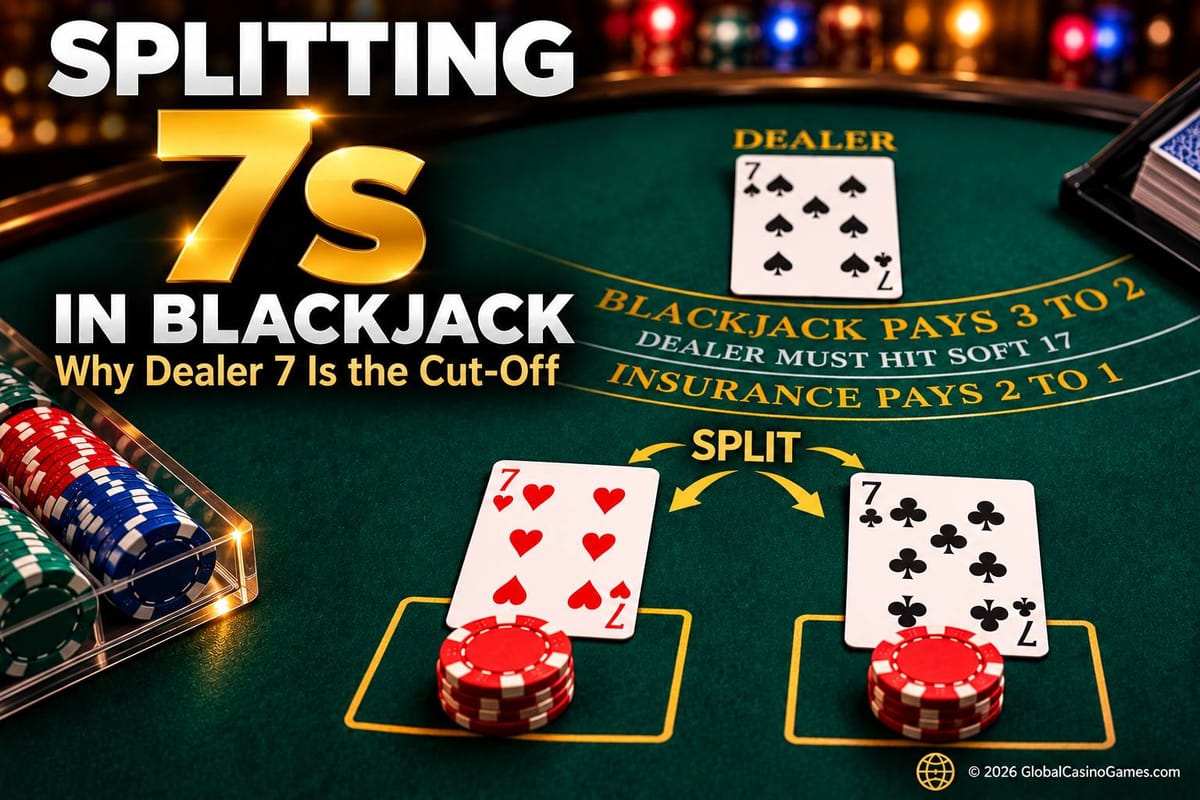
Two 7s make hard 14 — one of blackjack’s uncomfortable totals. Splitting can rescue the hand against the right dealer cards, but one small change in the dealer upcard can completely reverse the decision.
Written by Stephen Tabone for GlobalCasinoGames.com | Based on my own analysis and research, and fact-checked against established blackjack mathematics, basic-strategy research and published rules on pair splitting | Last reviewed: 1 October 2026
In a common multi-deck blackjack game, you normally split 7s against dealer 2 through 7 and hit against dealer 8 through Ace.
That creates one of the cleanest dividing lines in blackjack pair strategy.
Dealer 7?
Split.
Dealer 8?
Hit.
At first, that one-card difference can seem surprisingly important.
But the real story begins with what you already hold:
7 + 7 = hard 14
Hard 14 is not a hand you particularly want to protect.
Pair 7s have a memorable dealer-7 cut-off under common multi-deck blackjack rules. Pair 3s require a more conditional approach because the availability of DAS changes the dealer upcards against which splitting is correct. Continue with my guide to splitting 3s in blackjack.
Should You Split 7s in Blackjack?
For a common multi-deck game, the usual basic-strategy pattern is:
| Dealer Upcard | Usual Play |
|---|---|
| 2–7 | Split |
| 8–Ace | Hit |
Unlike pairs such as 4s and 6s, the standard multi-deck decision for 7s is generally not dependent on whether Double After Split is available.
For the wider mathematics behind hard totals, dealer upcards and pair decisions, see my Blackjack Basic Strategy and Mathematics Guide.
Why Split 7s Instead of Playing Hard 14?
If you keep the pair together, you have hard 14.
Against a dealer 2 through 6, standing on 14 may sometimes be appropriate because the dealer is vulnerable.
But when you hold an actual pair of 7s, blackjack gives you another option:
break the 14 apart.
You now have two hands beginning with:
7
and
7
Consider what one additional card can do:
7 + 10-value card = 17
7 + 9 = 16
7 + 8 = 15
7 + 4 = 11
7 + 3 = 10
The 10 and 11 possibilities can become particularly useful if doubling after split is permitted.
More importantly, you have escaped from one fixed hard 14 and created two separate chances to build a better total.
Why Do You Still Split 7s Against Dealer 7?
This is the most interesting decision in my article.
Dealer 7 is not normally grouped with the classic weak dealer cards of 4, 5 and 6.
So why split?
Because your alternative is not particularly attractive.
You are holding:
14 against dealer 7
If you simply hit, you risk busting immediately with an 8, 9 or any 10-value card.
Splitting changes the structure completely.
Each new hand begins on 7. A 10-value card creates 17 — enough to compete with a dealer finishing on 17 rather than immediately busting your original 14.
That is why the splitting range extends one step beyond the dealer’s traditional bust-prone zone.
Dealer 7 is the last upcard where breaking apart the 14 is normally worth the additional wager.
Why Does Dealer 8 Change Everything?
Move the dealer’s upcard from 7 to 8 and the strategy flips:
7 + 7 vs dealer 8 = Hit
Why?
Imagine splitting and then receiving a 10-value card.
You make:
17
Against dealer 7, that can be competitive.
Against dealer 8, 17 is already much less comfortable because the dealer has a stronger starting position and is more likely to finish with 18 or better.
Now you have another problem.
Splitting requires you to place a second wager.
Against a strong dealer card, you are potentially doubling your exposure while starting both new hands with only 7.
So from dealer 8 upward, basic strategy prefers to keep one wager in action and hit the hard 14.
7s and 6s: One Extra Dealer Card Makes the Difference
The progression from 6s to 7s is useful.
With a pair of 6s under common multi-deck rules:
Split against 2–6 with DAS.
With a pair of 7s:
Split against 2–7.
The extra dealer card matters because the split 7 has a natural route to 17 with any 10-value card.
That makes dealer 7 a viable splitting target in a way it normally is not for 6-6.
I explain that neighbouring decision in my Splitting 6s in Blackjack guide.
Looking at consecutive pairs like this helps show that pair strategy is not arbitrary. Each number changes what the next card can build.
What If You Receive Another 7 After Splitting?
If the casino allows resplitting, another 7 can usually be separated again by placing an additional wager.
For example:
7 → receives another 7
may become two more starting hands.
But resplitting rules vary.
Before playing, it is worth checking:
- whether pairs can be resplit;
- how many split hands are allowed;
- whether DAS is available;
- how many decks are being used.
Deck count matters because some single- or double-deck games can produce different borderline decisions, including situations where splitting 7s against dealer 8 becomes correct.
Why 7s Are Different From 8s
There is also an important contrast with the next pair up.
7 + 7 = hard 14
You split only against part of the dealer range.
8 + 8 = hard 16
Under ordinary basic strategy, that pair is split far more aggressively because hard 16 is an even more difficult starting hand.
So the lesson is not simply:
“Bad totals should be split.”
The real question is:
Does creating two new hands produce more value than keeping the original total against this particular dealer card?
The 7s Rule to Remember
For the common multi-deck game:
Dealer 2 through 7 = Split.
Dealer 8 through Ace = Hit.
The easiest boundary to remember is:
Split through the dealer 7. Stop at the dealer 8.
Two 7s give you hard 14, but they also give you an escape route.
Against dealer 2 through 7, take it.
Against dealer 8 or stronger, keep the second wager off the table and hit instead.
To compare 7s with every other matching pair, explore my complete casino blackjack pair-splitting guide, covering Aces and every pair from 2s through 10s.