
Splitting 4s in Blackjack: Why DAS Changes the Decision
Should you split 4s in blackjack? Usually only against dealer 5 or 6 when DAS is allowed. Learn why this unusual pair depends heavily on table rules.

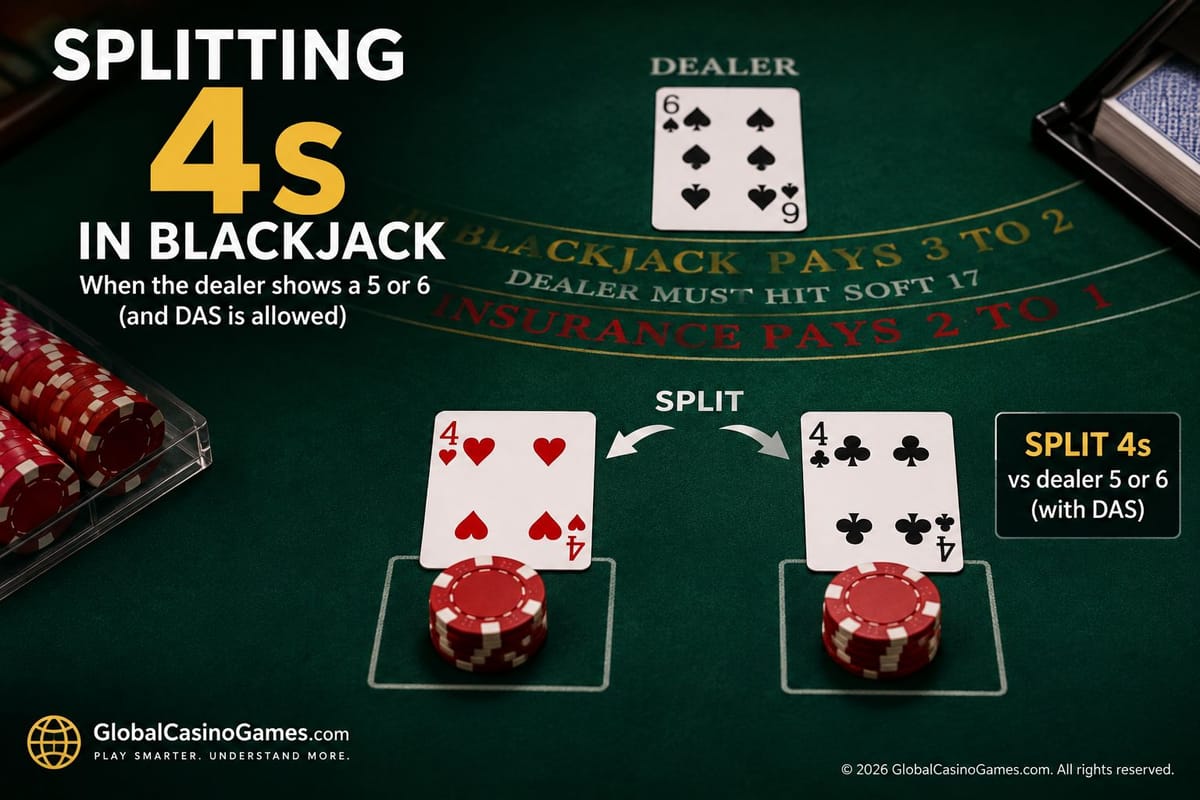
Should you split 4s in blackjack? The answer depends on one table rule that many players overlook: whether you can double after splitting.
Written by Stephen Tabone for GlobalCasinoGames.com | Based on my own analysis and research, and fact-checked against established blackjack mathematics, basic-strategy research and published rules on pair splitting and doubling after split | Last reviewed: 22 September 2026
In common multi-deck blackjack, split 4s against a dealer 5 or 6 only when doubling after split (DAS) is allowed; otherwise, play 4-4 as a hard 8 and hit.
That makes 4s one of the strangest pairs in blackjack.
Aces are famous for being split. So are 8s.
But two 4s?
At first sight, splitting them looks unnecessary.
You already have:
4 + 4 = hard 8
You cannot bust by taking one additional card. So why put a second wager on the table and turn one playable 8 into two hands beginning with only 4?
The answer is not really about the 4s.
It is about what those 4s can become next.
Pair 4s show how DAS can turn a normally weak splitting opportunity into the correct play against selected dealer upcards. The same rule also influences pair 6s, although the recommended splitting range is considerably broader. Continue with my guide to splitting 6s in blackjack.
Should You Split 4s in Blackjack?
For a common multi-deck game:
| Dealer Upcard | DAS Allowed | No DAS |
|---|---|---|
| 2–4 | Hit | Hit |
| 5–6 | Split | Hit |
| 7–Ace | Hit | Hit |
DAS = Double After Split.
So this pair has a remarkably narrow splitting window:
Dealer 5 or 6 + DAS = Split.
Almost everything else = Hit.
For the wider mathematics behind dealer upcards, doubling and pair decisions, see my Blackjack Basic Strategy and Mathematics Guide.
Why Does DAS Make Splitting 4s Worthwhile?
Imagine you have £10 on:
Logic Checkpoint: Doubling vs. Splitting
Click below to reveal why doubling a hard 8 and splitting a pair of 4s are completely different mathematical scenarios.
"If I split to chase a double total, I should just double the 8 right now."
It is easy to think that skipping the split and doubling the original 4-4 total accomplishes the same goal while saving time. However, this completely conflates your starting hand with your potential secondary hands.
4 + 4
and the dealer shows 6.
If you hit, you continue with one £10 hard-8 hand.
If you split, you add another £10 and create two hands beginning with:
4
and
4
Now look at three possible cards:
4 + 5 = 9
4 + 6 = 10
4 + 7 = 11
Those are precisely the kinds of two-card totals that can create strong doubling opportunities against a weak dealer 5 or 6.
That is where DAS earns its value.
You are not splitting because a lone 4 is a wonderful starting hand.
You are splitting because two starting 4s give you two opportunities to build 9, 10 or 11 — and DAS lets you put more money behind those favourable situations.
Without that follow-up double, much of the reason for splitting disappears.
Why Not Just Double the Original Hard 8?
This is where players can get the logic backwards.
If splitting becomes valuable because you might later double a 9, 10 or 11, why not just double the original 8?
Because they are different mathematical situations.
Hard 8 is normally a hit, not a basic-strategy double.
The valuable totals appear after you split and receive another card.
So:
4 + 4 = Hit or Split
but perhaps:
4 + 7 = 11 → Double
The split creates the opportunity. It does not mean the original 8 was a doubling hand.
Why Not Split 4s Against a Dealer 4?
This is another good question.
Dealer 4 is normally regarded as a weak upcard, so why does the splitting range stop at 5 and 6?
Because “dealer has a weak card” is not enough by itself.
You are paying for a second hand when you split. Basic strategy compares that extra exposure with simply hitting the hard 8.
Against dealer 4, under common multi-deck rules, the additional value from creating two 4-based hands is not enough to justify the split.
Against 5 and 6 with DAS, it is.
That narrow difference is exactly why 4s are easy to misplay.
What If Double After Split Is Not Allowed?
Then the strategy becomes wonderfully simple:
Do not split the 4s. Hit the hard 8.
No DAS removes the feature that makes splitting attractive against 5 and 6.
This is also why checking blackjack table rules matters before memorising a strategy chart. Two tables can deal the same cards but require a different correct decision.
4s and 8s: Two Completely Different Splits
Compare 4s with one of blackjack's most famous pairs.
8 + 8 = hard 16
Splitting usually helps escape one of the game's most awkward totals.
4 + 4 = hard 8
Hard 8 is not trapped. You can safely take another card without busting.
That is why 8s are usually broken apart, while 4s require a very specific combination of dealer weakness and DAS.
I explain the other side of that contrast in my Splitting 8s in Blackjack guide.
An Old Blackjack Puzzle That Still Matters
Pair-of-4 strategy has challenged intuition for decades.
The landmark 1956 mathematical analysis The Optimum Strategy in Blackjack specifically identified 4s among the pair decisions that could defy even experienced players' intuition.
That remains true today.
The cards look simple.
The decision is not.
The 4s Rule to Remember
Do not memorise:
“Always split 4s.”
And do not memorise:
“Never split 4s.”
Remember this instead:
5 or 6 + DAS = split the 4s.
Anything else in the common multi-deck game = hit the hard 8.
With 4s, the value is not sitting in the pair you have.
It is hidden in the doubling opportunities the split may create next.
To compare 4s with every other matching pair, explore my complete casino blackjack pair-splitting guide, covering Aces and every pair from 2s through 10s.