Blackjack Strategy Questions Answered: House Edge, Insurance, Doubling, Splitting and Winning Odds
Clear answers to common blackjack questions covering house edge, insurance, splitting, doubling, card counting and long-term winning odds.

Common blackjack strategy questions explained through probability and basic strategy.Written by Stephen Tabone for GlobalCasinoGames.com | Based on my own analysis and research, and fact-checked against established blackjack mathematics, basic-strategy principles and published casino rules | Last reviewed: 2 October 2026
Blackjack generates more strategy questions than almost any other casino game. Can you actually beat the house? Is there a most profitable bet? Why do players lose even when they use basic strategy? Should you ever take insurance? And does card counting really change the mathematics?
These are useful questions because blackjack is unusual among casino games. The cards are random, but the player's decisions directly affect the expected result. Choosing whether to hit, stand, double or split can either reduce the casino advantage or make it considerably worse.
There is no strategy that guarantees a profit, but understanding how blackjack actually works can prevent many of the most expensive mistakes players make.
Can You Really Beat the House at Blackjack?
In the short term, yes. Any individual blackjack session can end with the player ahead. That does not mean the game has been mathematically beaten.
Under favourable rules and accurate basic strategy, blackjack can have one of the lowest house edges in the casino. Depending on the exact rules, the casino advantage can fall below 1%.
That is very different from saying the player has a guaranteed winning system.
Over a typical sequence of hands, a blackjack player may win roughly 42–43% of hands and lose around 48–49%, with the remainder being pushes. Those figures vary with the rules and playing decisions.
The reason blackjack can still have a relatively low house edge is that winning hands can include blackjacks paying 3:2, doubles, splits and other situations where the amount won is not always identical.
The objective is therefore not to “win most hands.” It is to make mathematically efficient decisions.
For a detailed explanation of this, see the Blackjack Basic Strategy and Mathematics Guide.
What Is the Most Profitable Bet in Blackjack?
There is no single opening bet that automatically becomes profitable.
Your normal blackjack wager is still subject to the house edge. Increasing the size of that wager does not improve the underlying mathematics.
What matters more is what happens after the cards are dealt.
For example, doubling a hard 11 against a dealer 6 can be a strong basic-strategy play because the player has an excellent opportunity to improve the hand while the dealer is starting from a relatively weak upcard.
That does not mean doubling 11 always wins. It means that, over many comparable situations, doubling can produce a better expected result than simply hitting.
This distinction is central to blackjack strategy: the best decision is not necessarily the one that wins the current hand. It is the decision expected to lose less or win more over a very large number of hands.
Do Blackjack Players Always Lose Eventually?
Not necessarily as individuals.
Some players will leave a casino after winning. Others can experience long winning periods simply because short-term results contain considerable variance.
The casino advantage becomes more meaningful as the number of hands increases.
Imagine playing only ten hands. Almost anything can happen. You could win eight, lose two and leave with a substantial profit.
Now imagine playing hundreds of thousands of hands under identical conditions. Random swings still occur, but results increasingly reflect the mathematical expectation of the game.
This is why a winning evening does not disprove the house edge, just as a losing evening does not prove that a player used the wrong strategy.
Blackjack combines mathematics with variance, and the two should not be confused.
Should You Take Insurance When the Dealer Shows an Ace?
Insurance is one of the most misunderstood bets in blackjack.
When the dealer shows an Ace, the player may normally place an additional insurance wager of up to half the original bet. Insurance pays 2:1 if the dealer's hidden card is worth ten and therefore completes a blackjack.
At first glance, that can sound attractive.
Mathematically, however, the insurance wager needs the dealer to have a ten-value hole card more than one-third of the time to become favourable. The break-even point is approximately 33.33%.
Under ordinary conditions, basic strategy therefore normally says do not take insurance.
Insurance becomes more interesting to advanced card counters because the composition of the remaining shoe can sometimes indicate that an unusually large proportion of ten-value cards remains. That is a very different situation from taking insurance simply because the player is worried about losing the original hand.
Is Blackjack More Strategic Than Baccarat?
Yes, in an important mathematical sense.
In baccarat, once the wager has been placed, the drawing rules normally determine what happens next. The player does not decide whether the Player or Banker hand should draw another card.
Blackjack is different.
The player repeatedly makes decisions that affect expected value:
- hit or stand;
- double or continue normally;
- split or keep the pair together;
- surrender where permitted;
- accept or reject insurance.
Two people can therefore receive identical blackjack hands and produce different long-term results because one consistently follows mathematically stronger decisions.
That is why learning basic strategy matters much more in blackjack than memorising betting progressions.
When Should You Double Down or Split a Pair?
Doubling and pair splitting are two areas where intuition often conflicts with mathematics.
A player may hesitate to double because it requires putting more money at risk. Yet there are situations where doubling is mathematically preferable precisely because the player's hand is unusually strong relative to the dealer's position.
Pair splitting can be even less intuitive.
Two cards with the same value do not automatically mean “split.” Some pairs are normally split aggressively, while others are usually kept together.
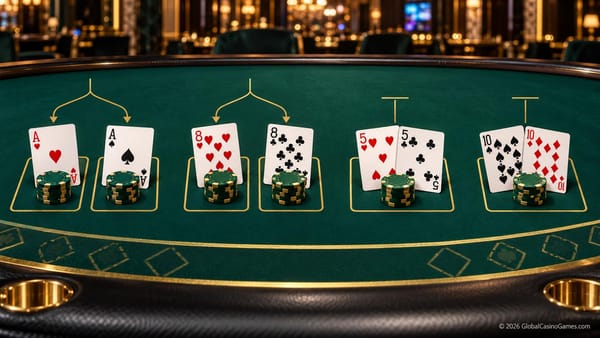
A pair of 8s, for example, creates a hard 16, one of the weakest starting totals in blackjack. Splitting the 8s gives the player two opportunities to build stronger hands.
By contrast, splitting a pair of 10s normally turns an excellent total of 20 into two unfinished hands. Basic strategy therefore usually keeps the 20 intact.
Rules such as whether doubling after splitting is permitted can also change the correct decision.
For a broader introduction to these decisions, see How to Play Blackjack: Mini Guide to Rules, Strategy and Betting.
For a complete pair-by-pair comparison, see my casino blackjack pair-splitting guide, covering Aces through 10s, dealer upcards, DAS and the correct basic-strategy decision for every pair.
Does Card Counting Guarantee That You Will Win?
No.
Card counting is often presented as though it predicts the next card. It does not.
A counting system attempts to estimate whether the remaining cards are unusually favourable to the player or dealer. A shoe containing a greater proportion of high cards can improve certain player outcomes, including blackjacks and successful doubles.
A skilled counter may therefore increase wagers when conditions appear favourable and reduce them when they do not.
Even with an advantage, however, individual hands remain unpredictable. A card counter can lose several sessions in succession while making mathematically correct decisions.
Counting changes expected value; it does not remove variance.
What Is the Most Important Blackjack Advice?
Start with the mathematics rather than the betting system.
Choose a table paying 3:2 for blackjack rather than weaker 6:5 games where possible. Learn basic strategy for the rules you are actually playing. Understand doubling and splitting. Avoid treating insurance as automatic protection. Be cautious with side bets, and never assume that increasing your stake can recover previous losses.
Blackjack is not a game where the house edge disappears because a player has discovered a clever betting pattern.
Its real attraction is more interesting than that.
Blackjack gives the player genuine decisions, and those decisions have measurable mathematical consequences. The better you understand them, the less of the casino's advantage you unnecessarily give away.